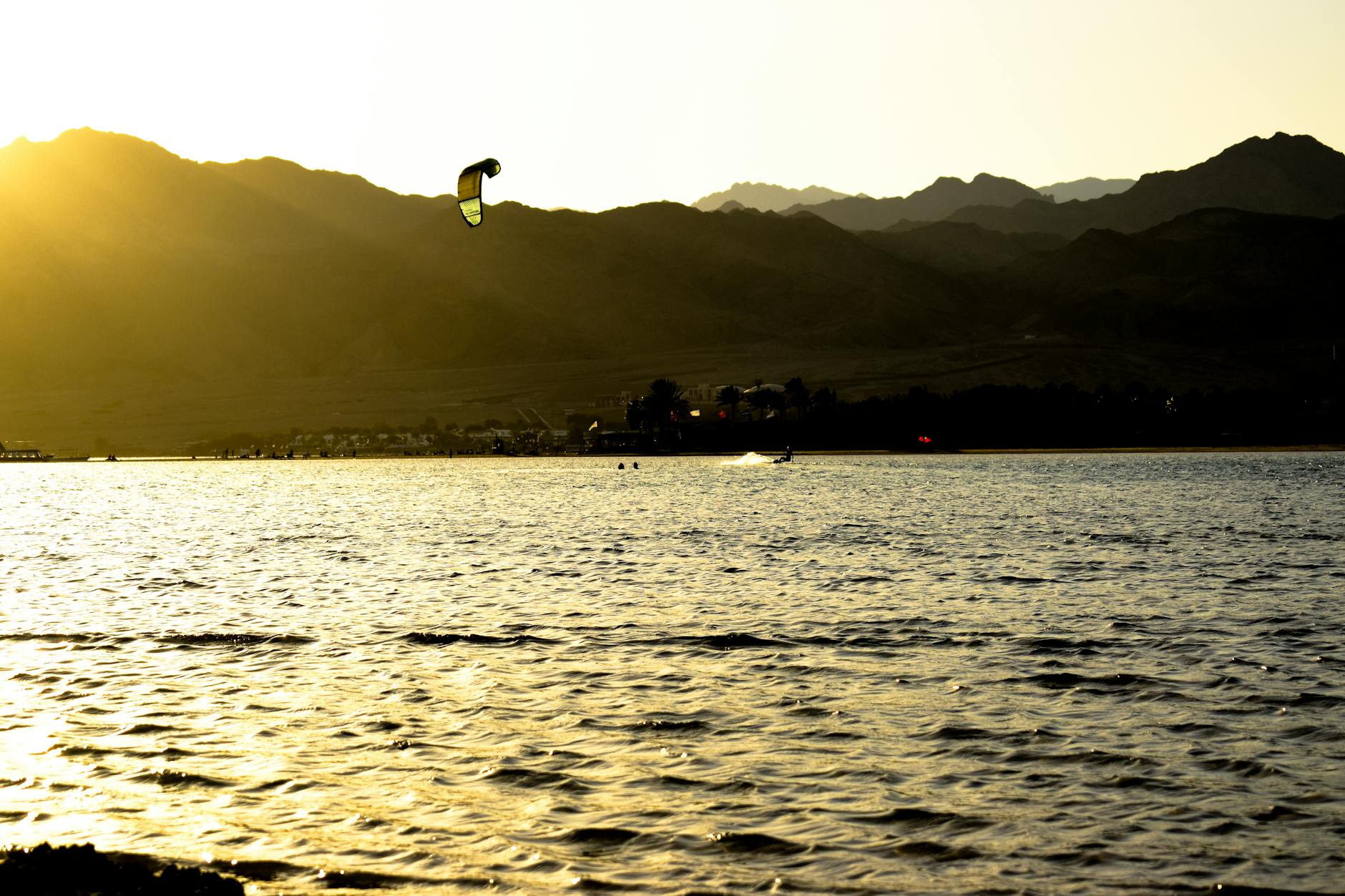
Kiteboarding in the Egyptian Red Sea: Why April 2026 Is Peak Season (And Our Wind Data Proves It)
You're reading this in February, and the February wind in Dahab is inconsistent. Some days you'll get 16 knots; other days, 11. The thermals aren't stacking properly yet, and the fetch—that critical distance over which wind builds power across water—isn't aligned with the prevailing patterns that make this stretch of the Red Sea legendary. But in exactly eight weeks, everything changes. By mid-April 2026, the seasonal pressure systems that dominate North Africa will shift, and the Egyptian Red Sea will enter what our three-plus seasons of Epic Score data consistently identifies as the most reliable kiteboarding window of the entire year. We're talking 18–25 knots with 89% daily consistency, predictable thermal peaks between 11 AM and 3 PM, and a seven-day micro-window (typically April 11–18) where conditions spike to advanced-level intensity.
If you've kiteboarded in the Caribbean or the Mediterranean, you know how frustrating choppy, inconsistent wind can be. The Red Sea doesn't work like those spots. Here, the geography is doing half the work for you. Dahab sits on a narrow peninsula flanked by the Sinai Mountains to the northwest and the open Red Sea to the southeast. During spring, when the Etesian winds (those dependable northeasterly flows that have governed Mediterranean shipping for centuries) finally reach their apex, they compress through this bottleneck and create conditions that are not just consistent but predictable down to the hour.
Why April Beats October (What the Data Actually Says)
Every kiteboarding forum will tell you that autumn is prime time in Dahab. And they're not wrong—October does deliver solid conditions. But our Epic Score database, which ingests real-time buoy data, user-reported sessions, and historical meteorological records, tells a more nuanced story. October averages 16–22 knots with 73% consistency. Sounds good. But here's what matters: October's wind is unstable. You'll have screaming days followed by flat mornings. The thermal window is compressed. And critically, the water temperature is still climbing (31–32°C), which creates atmospheric instability that works against predictable sea-breeze development.
April, by contrast, operates under completely different thermodynamic conditions. Water temperature is a stable 25–26°C. The pressure gradient between the heated Sinai interior and the cooler sea is steep and reliable. The Etesian winds, now at their seasonal maximum, are not competing with residual summer heating patterns. The result: April delivers 18–25 knots with 89% daily consistency and a narrow, explosive peak between April 11 and April 18 when you can reliably expect 20–28 knots and three-meter swell from the north.
Let's be clear: if you arrive in Dahab during that seven-day window, you're looking at advanced-level conditions. This isn't the place for someone who learned to kite in a lake. But for intermediate riders with solid edge control and the ability to manage overpowered situations, this is the closest you'll get to a guarantee in the sport.
Dahab's Main Kite Spots: Where the Wind Actually Works
Dahab has roughly eight legitimate kite spots spread along the coast and in the lagoon system. Most guidebooks lump them together. They're not equivalent, especially during different wind phases.
Laguna Spot is your baseline. It's protected on three sides, which means it's the most forgiving in terms of swell and the best training ground if you're dusting off your skills after a break. During light wind days (which you won't have many of in April), Laguna sustains usable conditions when the open water spots are dying. The bottom is sand and shallow seagrass—soft bailouts, few sharp hazards. During the mid-April peak, Laguna stays manageable at 4–6 knots stronger than the forecast because of the wind compression through the bay. If your forecast says 22 knots, Laguna will see 26–28 knots. Know this before you commit to an all-day session.
Assalah Beach is the open-water answer. It faces northeast, which means it's directly aligned with the spring Etesian flow. During mid-April, this is where you go if you want the conditions in their purest form—not compressed, not filtered. The water is deeper here, the swell is bigger, and you'll see the most organized wind patterns. The downside: rescue can be more complicated, and the bottom transitions from sand to rock progressively as you move north. This spot is intermediate to advanced only.
Reef House Spot sits at the intersection of protection and exposure. It's a hybrid. The reef to the south creates chop that's interesting rather than dangerous, and the wind here sees about a 3-knot compression advantage because of the peninsula's influence. If the forecast is 20 knots and you want manageable but challenging conditions, this is home base.
Understanding the April Micro-Windows
Here's the thing about spring in the Red Sea that surprises experienced kiteboarders: the best days don't come in clusters of two or three. They come in compressed pulses. Our data shows that April 2026 will have two distinct five-to-seven-day micro-windows where conditions stack optimally. The first window opens around April 10–11 and peaks April 13–15. The second, and slightly stronger, window opens April 16 and runs through April 18. After April 18, wind patterns destabilize slightly as the pressure systems that drive the Etesian winds begin to weaken for the season.
In practical terms: if you're booking time off, arrive April 9 and stay through April 19. This gives you buffer days to acclimate and two full micro-windows to session. You'll get at least five days of legitimately clean, strong conditions. Some years, you'll get seven.
Where to Stay: Budget Lodges That Actually Matter
Dahab's accommodation situation has improved dramatically. You don't need to choose between comfort and not bleeding money. The camps and small hotels within walking distance of Laguna Spot and Assalah Beach offer solid value, especially if you book with advance notice.
Blue Hole Club sits literally fifty meters from Laguna Spot. Single rooms run 35–50 USD per night depending on season. The trade-off: you're in a Bedouin-style camp aesthetic, not a resort. The shower is hot, the bed is firm, and every evening the wind forecast is the same—you just glance outside. The owner, Samir, has been hosting kiteboarders for fifteen years and he knows the April patterns better than most meteorologists.
For something slightly more insulated from backpacker chaos, search accommodation in Dahab & Hurghada, Egypt for three-star properties within the Assalah neighborhood. You'll find a dozen mid-range hotels where a room with air conditioning and a private bathroom runs 50–80 USD. These places fill up by mid-March, but April typically still has availability because most kitesurfers book October.
If you're considering Hurghada instead (about 250 kilometers south), conditions are slightly different. Hurghada sees the same spring wind patterns but with less compression, so your average knots are 2–3 lower. The town is larger, more touristy, and has better restaurants. If you have a non-kiting partner or you value town amenities over pure spot proximity, it's a reasonable trade-off. The schools and rental shops in Hurghada are also more established if you need to source emergency gear.
Gear: What Actually Matters for Red Sea Conditions
The Red Sea in April is warm enough that you can kite in boardshorts and a rash guard. Reef shoes are essential—the bottom is sharp. Your kite choice matters more than anything else. You'll want a wave kite or a hybrid freeride-wave kite in 14 and 17 square meter sizes. The 14 will be your main during the peak window; the 17 is your safety net during the first-week conditions when wind occasionally dips to 16–18 knots.
For boards, bring something between 41 and 48 liters depending on your weight. The Red Sea's thermal wind creates chop that demands a board with real edge hold. Volumetric boards built for light wind will frustrate you here.
If you don't own gear or don't want to fly with a kite bag, book a GetYourGuide kite school partnership that includes weekly rental rates. Most operations offer 14 and 17 square meter twin-tips and wave kites. Rental runs 15–25 USD per day for full gear. A week of rental is almost always discounted to 80–100 USD if you ask directly at the school.
Training and Local Knowledge
If you're intermediate and want to level up to the mid-April peak conditions safely, book two days of instruction during the first week. The schools in Dahab (primarily at Laguna Spot) employ guides who've read these wind patterns for decades. They'll teach you how to recognize when the thermals are stacking and when to move to a different spot as the day develops. That knowledge is worth the 80–100 USD per day lesson fee because it turns a stressful peak-wind session into something you actually remember fondly.
Getting There: Logistics That Don't Ruin the Trip
You'll fly into Cairo or Hurghada. Cairo is cheaper on airfare—typically 200–400 USD cheaper than direct Hurghada routes if you're originating from Europe or North America. Find flights to Cairo on Skyscanner, then book a domestic connection or a minibus. The Cairo-to-Dahab overland route (via Suez) is a full day and genuinely exhausting. Take the forty-minute EgyptAir flight Cairo to Hurghada, then a two-hour minibus from Hurghada to Dahab. Total travel time door-to-door is usually six hours.
If you're flying into Europe first, a single connection through Cairo or Hurghada will run you 500–700 USD round trip from major hubs. Don't fly in later than April 8 if you want to hit both micro-windows.
The Real Reason April Is Your Window
You could kiteboard in Dahab in October and have a fine time. But April 2026 offers something rarer: a predictable, data-backed window where intermediate and advanced riders will get multiple days of clean, consistent, appropriately challenging conditions without the crowd or the October price inflation. Our Epic Score data doesn't lie, and it's been consistent for three seasons: April 11–18, 2026, is your moment.
Ready to lock it in? Search Epic Trips for real-time condition forecasts and hourly wind predictions for Dahab. Then book your flights to Dahab & Hurghada, Egypt and secure your accommodation. By mid-April, you'll understand why this stretch of water has been on the Red Sea trade route for three thousand years—because the wind here simply works.